
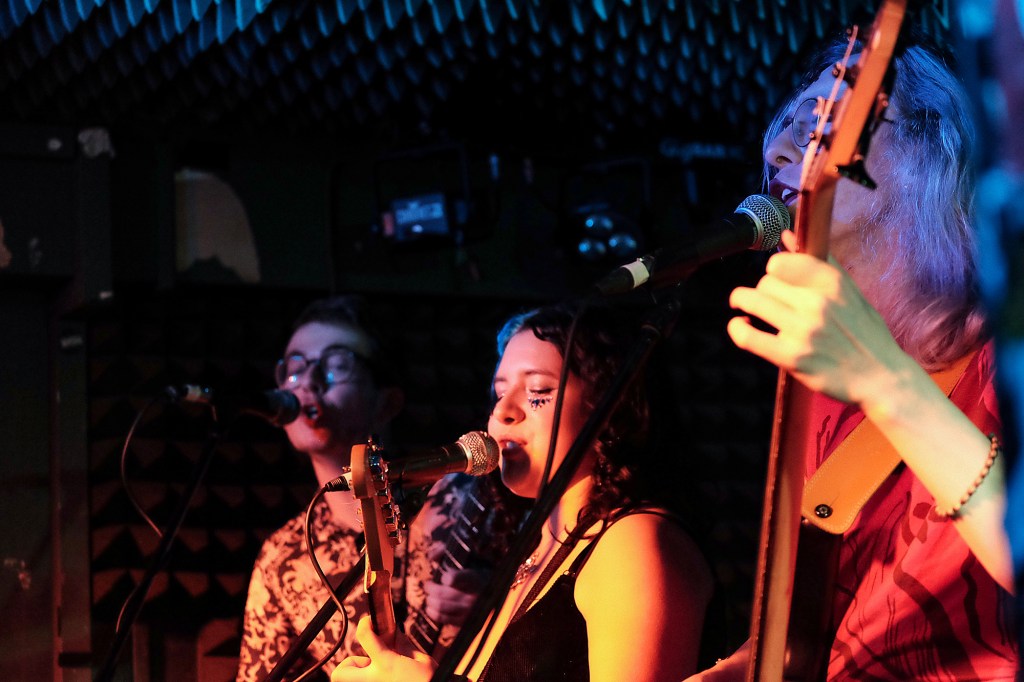
Just after the recent release of their first EP, Discovery Bluff, I sat down with the members of Space Octopus Cartel, an ambitious prog band who are paying homage to the genre’s legends while maintaining a catchy, rhythmic focus. The band’s members, Guinevere Klein, Alex Heard, Becky Hipson, Jake Currant, and Benny Thompson, perform in London and beyond, bringing searing synth melodies and vibrant vocals to the city’s varied independent scene. In our wide-ranging Zoom conversation, we touched upon prog’s critical reception, lyric-writing for a turbulent age, and our mutual connection to the University of Warwick.
Joe: You mostly met at Warwick University’s BandSoc, a thriving music society with a great ‘Battle of the Bands’ competition that I attended a few times. Can you describe these experiences up to the formation of your current outfit?
Guinevere: Benny and I met while playing in a jazz band at Warwick uni, in BandSoc. Then, a few years later, Becky joined the society, where we met at social events. When Benny and I left university, we started playing in the London collective Big Band, which Jake runs – which used to be the Warwick alumni Big Band. As far as I’m aware, it started dying, so people from other unis started joining, which is how we met Jake, who was playing drums at the time – and Alex, our guitarist, who isn’t here. We all thought, ‘I love prog, shall we make some music?’ And then I was ill for a year, and we didn’t any. And I came back, and was like, ‘Right, let’s actually do it’. So we started rehearsing – just Jake, Alex, Benedict, and myself. At first, I was going to sing, but I wasn’t very good at singing and playing bass at the same time. The singer quest began. ‘Who do we know that sings? Oh, I know Becky… I wonder if she lives in London. She does! Becky, will you please come and sing for us?’ That was about eight months ago… I think I’ve covered the deep lore.
Was there anything about BandSoc in particular that you found galvanising as musicians? I felt it was a unique scene for a non-music-orientated university.
Becky: For me personally, I hadn’t really been doing much music up until joining the society. This was late 2019. I’d done the odd gig – secondary school, assemblies and stuff like that – but I didn’t play much outside of that. And I’d been primarily self-taught with the guitar and bass. Discovering the society, and being in a few bands, mainly as a singer, but then later picking up the bass for Deadline Escape, who you might remember… for me it was a great rekindling of my love of music. I’ve always loved how diverse genre-wise the society has been, which has only continued since we left. Seeing the scene now, and how much its grown, has been really cool.
GK: One thing I’d add to that… the point about Warwick not having a music department: I actually found that a real positive. If there’s people who’s degree it is to practice four or five hours a day, then they’re gonna be the ones doing everything. It opens up the playing field a bit more. Ah, it’s Benny! (Benny joins the interview, sitting behind Guinevere.)
Jake: There’s my guy.
GK: This is our wonderful keys player. What did you think about BandSoc?
Benny: It was alright.
Prog music seems to be undergoing a period of relative popularity at the moment. For many years, bands such as Genesis and Yes were derided as being excessive, with King Crimson being a notable exception. What were the groups and styles that made you excited about progressive music?
GK: I’ll start, as I’m probably the biggest prog-head, maybe – maybe Jake, though. You’re seeing a lot of influence of bands like King Gizzard and the Lizard Wizard, in that they have a lot of appeal to people who wouldn’t usually like music that is much more technical – they do psych rock and stoner rock stuff, injecting in the complicated time signatures – and also people like Steven Wilson, trying to move into a pop direction, though it’s had mixed success recently. As pop music has become simpler, there’s a move in the last five to ten years, towards actual bands doing stuff. This opens the door to prog… this could just be a load of nonsense I’m chatting. In terms of bands that got me into the genre: Haken, number one, the UK-based prog-metal band. The keys player of our old band force-fed me prog for several years, so: Genesis, King Crimson, and more modern stuff like The Dear Hunter, and Leprous on the metal side. Benny, would you like to chip in?
BT: Well, I don’t listen to prog.
JC: I think that nowadays, lots of artists are more thoughtful about how to convey weird technical stuff in a palatable way. For me, the absolute pinnacle of this is Rush, because they became so widespread through thinking this through in an accessible way. If you watch the R40 tour, you’ll see people air-drumming along to Neil Peart – these people don’t play at all, it’s insane. Half of their songs are like four different songs glued together. But they spend the time trying to bring this across to people who wouldn’t care, which is something that has bled across to our work. How do you make those things listenable? To me, they’re heralds of that resurgence.
I don’t necessarily know you as a prog fan, Becky?
BH: I hadn’t listened to much of it at all. It’s been a nice exposure and way of easing into the genre, coming to really enjoy it. I genuinely love our songs: they’re so much fun, and there’s such a chemistry when we’re playing. I’ve come to enjoy Haken and Porcupine Tree too. I still probably have a lot to learn about the wider scope of the genre. I’d argue that you can hear what Jake’s saying in some of the post-punk bands that are getting more popular too. Bands like English Teacher; Black Country, New Road… they definitely have those technicalities infused into their music. Even black midi as a more extreme case. There’s some interesting crossover between these genres. I’ve come to enjoy both as a means to explore in my songwriting.
GK: Jazz has seen a similar resurgence in the UK, especially amongst younger people. This makes listeners more receptive to other stuff. Also, the internet’s been pretty good. Prog wouldn’t usually make it on the radio, but it’s much easier now to just Google it and think, ‘Oh, I like prog,’ and get into it.
The UK indie scene was certainly my way into these genres. I wonder if the pendulum swung a certain way in the mid-late 2000s, where there was a real embrace of garage rock revival and more direct songwriting styles. And now it’s gone the other way because it reached such a point of saturation. With regards to the freedom of jazz and prog in their improvisational aspects, how do you balance that with the tightness of the songs on the EP?
GK: It’s a battle, every rehearsal is a battle.
JC: That’s so good to hear [that the songs are succinct], because writing is an endless fight against massive improv sections. Almost everything on the EP was cut down in scope from how we were playing it live. Playing for more than a year before putting it to track, listening to it over and over… the songs just sounded so bloated. On ‘Cascade’, the bridge was twice as long as it is. And ‘Terra Nova’: we were soloing forever. We really consciously thought about that; there had to be a limit on it.
BT: There’s a distinction to be made between playing a song live and recording it. When something’s recorded, I’m much more in favour of distilling it to a core musical idea. Why use a paragraph when a sentence will do? It’s good to be as concise as possible. Also, we’re competing for attention with loads of other bands.
Can you talk about the topical focus of these songs, and how you go about writing lyrics that deal with pertinent issues such as climate change?
GK: How did you conceive of the lyrics, Benny?
BT: I woke up in the morning and realised that we now had a singer and needed some lyrics. That’s the short answer. The long answer is – I don’t know – I guess I’m not that interested in tackling issues, I’m more into storytelling. If any issues do creep in, that’s just stuff I’m surrounded by, that’s likely to filter through. It does happen; it’s quite indirect.
GK: See, I come up with lyrics in a completely different way. All the lyrics on the EP are Benny’s. There’s more of my stuff in the live set. I will either go completely fantastical, or I’ll try to be incredibly specific. Like, there’s a song about me having Crohn’s and dealing with the NHS, and it being fucking horrible. There’s multiple songs about being trans – there’s gonna be more, always. Something that I go back and forth on (with prog): there is that metaphor, but a lot of the time it is just lost. It’s gone too far, and I can’t tell what you’re on about. A lot of the time, songs written in a particular way, so as to not be specific, can be co-opted. There’s a lot of examples of far-right people using Rage Against the Machine, for instance. So when I write songs about being trans, I’m trying to make it clear that it’s these experiences I’m talking about, but also in a way that’s not twee and cringe. It’s a difficult line to walk, which has resulted in a lot of rewriting. Jake, how do you write lyrics?
JC: Let’s not talk about how I write lyrics.
BH: I’m actually curious!
JC: I’m a pure fiction writer, I like stories. My lyrics are always a fever dream.
BH: They’re also the hardest to perform live. All of these guys have such fun ideas. I’ve not yet written any lyrics for the band, as I’m so new to the genre.
Finally, what are your future plans for the band?
JC: In an immediate sense, we’re doing nothing for a while. Benny’s going away for a few months, so we’re gonna be on hiatus until October or so. The EP gives us a bit of legitimacy, something to bring to publications and stuff. Our broad goal is to get support slots for some actual bands, not promoter-led garbage. The second EP is basically sketched out. Our working rotation of songs is at about thirty, with around fifteen basically ready to go. We have enough mileage to plan another EP, a couple of albums, and get on some support slots.
GK: We need to build an actual following, because most of the listeners at the moment are friends or other people we know. And there’s only so many times you can ask those people to go to your gigs. There aren’t that many prog bands with members under fifty. Most of the time I go to shows, it’s men of fifty-five plus. I think being young in the prog space does give us a selling point. How many prog bands are there with two women in them? Like, none. I can’t think of any.
 The Beaten Track