
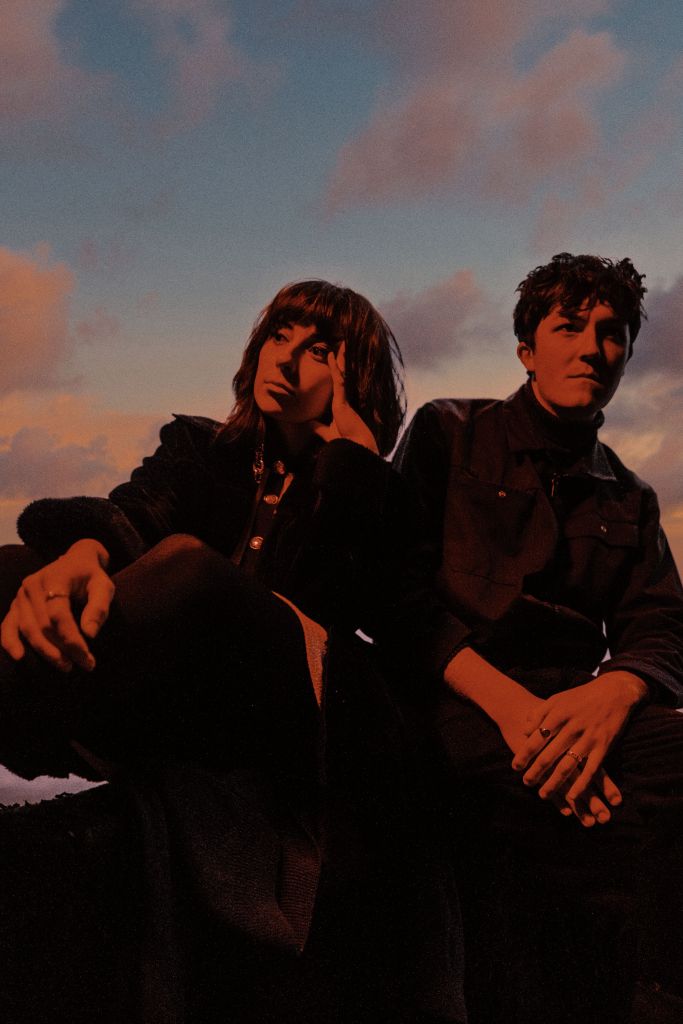
For our first interview on the site, I sat down (via Zoom) with Zia and Will, who together form the fabulous electronic duo jellyskin. Their debut LP In Brine released last month, comprising wall-to-wall techno bops that combine subversively submerged lyricism with noisy, progressive rhythms and complex song structures. Quite deservedly, the group’s unique approach has been praised by publications such as Louder Than War and The Quietus, affording them a spot supporting Sleaford Mods in Leeds later this year. We discussed their use of marine symbolism, adapting laptop music for a live audience, and how to be funny and sincere at the same time.
Joe: I wanted to start by asking about your inception as a band, as well as the shifts you’ve undertaken up to the release of In Brine.
Will: We just started going out, and then, about six months into that, we realised that we should make some music together. One day, we were like: ‘let’s just have a practice’. And we ended up practicing in my uni room. Our drummer played on a guitar case with some wooden spoons. Zia had one of those massive – you know like the keyboards you’d use in school? – one of those massive Casios. And I had my guitar. I think in that practice we ran through ‘Pulpy Mouth and Skin’, which is on the album – which I wrote when I was about seventeen. It’s obviously really different. In the past, I was trying to be like The Jesus and Mary Chain. We started off by playing shoegaze.
Zia: I don’t think that was on purpose, was it? I didn’t even know what shoegaze was, really, until we’d started releasing music – and people were like ‘oh my god, this new shoegaze band’ – and I was like ‘what is that?’ But I’d already been listening to that stuff without realising it, so I guess the influence seeped in a little. We were still very much figuring out what music we wanted to make at that point, and we weren’t doing shoegaze on purpose. I don’t think we really felt a hundred percent sure it was the music we wanted to make – which changed when we got the ideas for the songs that are now on the album. So yeah, we started out not really knowing what we were doing. But just, you know, being a bit DIY. And then we sacked off our drummer.
W: He moved away to Hong Kong.
Z: Yeah, he moved away. We let him off.
W: With the change in sound… a lot of bands talk about how they don’t plan what they write. But we were like ‘no, we want this to sound heavier.’ It was a deliberate choice to bring in more electronics. It was mainly because of club nights we’d go to in Leeds. We’d hear the music and say ‘yeah, this is sick. We should try to make more music like this.’ But it was a fairly gradual progression; you can hear it in the singles.
Z: I grew up listening to Goldfrapp and Leftfield and stuff like that – heavy electronic music, but with great vocals. It was definitely intentional; we wanted to beef it up a bit.
Was the EP a half-way point between the two styles, shoegaze and electronica?
W: That was more of a hodgepodge: some of the old stuff, some of the new stuff we were writing. I had written some without vocals, so it felt like less of a collaborative process. We were still finding our feet.
Z: We needed to put out a body of work to mark that point, going from old to new. Then we moved on to writing our recent singles, which was the advent of a new direction. Somebody bought the EP the other day! What a throwback.
W: It’s nice that with the album coming out, people have been going back to the older stuff. I’m not really a huge fan of it. It’s ok, but, yeah…
Do you think it’s a matter of slipping into shoegaze because the instrumental palette is there? You might be able to emulate it in a way that’s more –
Z: Lo-fi.
Yeah, lo-fi I suppose.
W: It’s not easy to do, but it’s quite fun, really. It’s just good to whack a load of fuzz on your guitar, and get some angelic vocals. It was good for us as a band because we could get something together quite quickly that sounded solid and powerful.
Z: It did take less time to do. I’m a lot prouder of the album’s overall sound. It reflects what we were trying to do a bit more. The stuff on the EP – we were less experienced – and with the album we had the help of our amazing friend Lewis [D-t], who’s a brilliant producer. He polished everything off.
I didn’t mean to imply that it was easy…
W: I know what you mean. It’s the equivalent to the first thing you do in a garage rock band or something. It’s a version of that basically.
The nautical aspects are always there, though. Is it true that you met in Leeds, a relatively landlocked UK city?
Z: It is true, yeah.
W: It’s an easy thing to write lyrics about.
Z: If you want to get deep, we were both raised with the sea very close by. We grew up with a separate love of the sea, and when we came together, we both had those influences. Leeds is very landlocked. Maybe we were subconsciously pining for the coast. It wasn’t deliberate in the early days. ‘Eater’ [from the self-titled EP] is about the eater crab, and that was from when we were on holiday together in Devon. Will came up with the title and I fleshed out the lyrics from there. When it came to the album, we decided to run with it. We already had the phrases ‘I Was The First Tetrapod’ and ‘Bringer Of Brine’. Those, we thought, were really strong songs, with a similar theme – so that filtered into the artwork and the rest of the album.
Did the conceptual focus ever feel quite risky, as though you were sacrificing a whole range of aesthetic or lyrical choices?
W: I think limits are good. Otherwise you get a mess of sounds. I really like albums that have a similar thematic register to them – there’s a few Beach Boys albums…
Z: I was waiting for him to bring up the Beach Boys. It only took ten minutes.
W: They’re never far away. But yeah, the limits are good because you end up with a more seamless thing; it’s all got a similar DNA. It’s a proper album rather than a collection of songs.
Z: Which the EP kind of was – because we wanted to cobble them together and call it an EP, rather than specifically working towards that. Having a loose theme was a good basis for structuring the release. A lot of the songs were already written before we’d decided to name the album In Brine and to market it in relation to that theme. I wouldn’t say it felt limiting, but I agree with Will that the idea allowed us to hone it a bit more.
W: And also, the theme of the album is mostly in the lyrics. All the songs sound pretty different, though they’re all hard and heavy, with jagged edges. It would have been limiting if we’d tried to make each song sound similar, or to get deep marine themes into the music. We almost reverse-engineered it, changing other lyrics due to the decision.
Z: We snuck watery lines into other songs, like the “shop-bought fish tin” from ‘Lift (Come In)’. That’s a hint of the theme and album cover.
W: There’s a running water sample on that song too.
Z: Is there?
W: Yeah, very faintly. Some of the lyrics are very nautically focused, but it almost became that way because we made such a big deal about it being that. It’s like nominative determinism: we called it In Brine, so it became an album about the sea. If you really look at it, it’s not a concept album or anything.
Z: If you took away the cover and the title, I don’t think people would really think of it that way. It’s just more fun for us. We loved making videos on the coast as well.
As you’ve alluded to with the Beach Boys, a lot of conceptual albums completely drift off from their core idea. It’s free flowing, but that can be quite welcoming as a listener – almost an entryway.
Z: Yeah, it’s cohesive, I guess.
W: That’s why it’s not limiting. There’re probably only three songs that are legitimately about the sea. And the rest might mention a fish or a squid or something.
Z: And then everyone would tweet about us as these ‘nautical newbies’ and such. It’s quite funny, really.
Did you see a conflict between the pulsing, recurrent beats of techno music and the catchy, empathic choruses of songs like ‘I was the First Tetrapod’ and ‘52 Blue’, the latter quite an earnest song about desire?
Z: At times we worried that the lyrics and the vocal wouldn’t marry up with the song. But we do like entertaining ourselves, putting those lyrics with a really heavy techno banger. We find it quite funny to do that.
W: It’s a hard balance to strike. You don’t want to come across as heavy music with sort of syrupy vocals; that can be a horrible combination. We learnt to make sure that the vocals weren’t taking themselves too seriously. That’s a good way of navigating the heaviness and the sweetness – making it sound almost like Confidence Man or something.
Z: The music of a song like ‘52 Blue’ – that could easily have had some cold techno vocal on it – but obviously there’s lots of that stuff out there. I grew up listening to the B52’s, who obviously have the comedic element in their lyrics; but very earnest as well – powerful vocals. On jarring, post-punky, dancey music. It’s something that feels quite natural to me. Yet it is hard sometimes to make it gel. Same thing with ‘Tetrapod’, really. The last thing we want is to be one of those very distant and pretentious electronic outfits.
When I discovered you guys on The Quietus’ year-so-far list, I was expecting something quite oblique. I think they described you as ‘experimental’, but that’s not what I found at all.
W: I wouldn’t say we’re experimental. Maybe in future we will be. But we’re definitely focused on making good, poppy songs.
Z: There’s a lot of pop influence. A lot of it is pretty accessible. After the mixing process, we couldn’t listen to the songs for ages. It sounded like sludge; it was such a long process. But I’ve got to the point now where I can enjoy listening to them as a punter, not just as us – which made me realise that it is quite accessible. But then, there are hints of experimental percussion and stuff.
Perhaps due to my lack of knowledge, I found myself thinking of two current groups, PVA and Jockstrap, while listening to your music. Do you have a sense of wider community while making music? Who are you passionate about at the moment?
W: I remember listening to a couple of the PVA songs; there’s definitely comparisons to be made. We don’t sound that similar though. I love Jockstrap – they’re so good. We sound less Londoney I think. But I haven’t heard enough PVA to pass comment. Jockstrap are quite experimental, I guess. They mix up genres in a way that is genuinely fresh. It’s something that I’d like to do more of.
Z: There are hints of that on our album. There’s the sort of Jungle-esque chorus of Fox Again – and then it goes back to a more poppy song. We’ve played with that a little bit. I love when people say ‘Oh, you reminded me of so-and-so’ and it’s somebody I haven’t really listened to. Because it’s like, ‘great, that’s somebody I can go and listen to now’. But then there’s the worry that people are gonna think we sound too much like someone else.
W: My favourite band at the moment is One More Grain.
Z: They’re experimental. Haha.
W: They’ve got like drum machines and brass, and it’s very cyclical and repetitive, almost like chants. And the main guy, Daniel Patrick Quinn, he’s kind of like Mark E. Smith – very enigmatic. They’re really good. I will never stop shouting about them. And nobody knows about them! Well, a few people do, but they’re not as widely known as they should be.
Z: And just to big up Leeds, as well: STRAIGHT GIRL – an incredible solo electronic artist. Same goes for Hang Linton, who’s another amazing solo performer.
I sense that your songs are made almost entirely using software, which must be hard to translate to a live setting. Do you feel you’ll have to retrofit these songs, so to speak?
W: We find playing live quite difficult sometimes. Because, yeah, a lot of it was created on a laptop. It’d be great to get like seven people to help us play the songs, but that’s just not feasible because we can’t play them –
Z: Can’t pay them.
W: It’s impossible to corral that many of our friends together and get them to do regular gigs and stuff. So, we have to rely heavily on backing tracks; that makes it a bit flat sometimes.
Z: It’s just a given that we’ll be playing to a stripped-down version of the track, and fleshing it out with the instruments that we do play. With the new songs that we’ve been writing, we’ve tried to do subtler backing tracks – in terms of percussion especially. Less samples and things like that too. It’s something we’re playing with. I also really hate the snobbery of ‘Oh they’ve got a backing track’ – there’s been a bit of that recently…
With Billy Nomates?
Z: It’s just so hostile and unnecessary. Everything that we play – whether it’s live, or on the backing track – we’ve created it all. So if you come and watch us live, everything you’re hearing we’ve created. It’s almost like a hybrid band/DJ vibe.
W: Sometimes I could happily not play live again. But sometimes you do and it’s great. It’s difficult for electronic artists to play live, basically. But Jockstrap – they must use backing tracks.
Z: And Sleaford Mods.
I was thinking of bringing up Sleaford Mods too, as there’s obviously a connection with Billy Nomates and with you guys. They’re a great live band. It’s weird that there’s such an aggressive response. As I’m sure you’re aware, there’s a lot of discourse at the moment about people’s etiquette at gigs, especially after covid.
Z: Just on a practical level, growing up working class, I didn’t have much access to equipment. So when I got my first synth that was all I had – just basic recording equipment, very DIY. We make the best with the resources we currently have. You know what you’re getting. If people don’t like watching semi-live, semi-backing track, then that’s fine. But, as you say, with Sleaford Mods, we’ve seen them a few times: they just put on a great show. It’s growing, the amount of people that play with a mixture of both. We’re not alone.
Now I have two questions from Louis, my wonderful co-host. Firstly, what do you think it is about the sea that fascinates us in music? Is it where we all came from and where we’re destined to go back to?
Z: Very existential. Especially with ‘I Was The First Tetrapod’… when Will came up with that phrase, I took it as a cocky statement… it turned into a song about growth and evolution. I don’t know how to be profound about this… Will, any ideas?
W: It’s just an easy thing to write lyrics about. There’s a rich heritage of bands constantly talking about the sea. The Beach Boys, obviously; but also The La’s, who I love. It fulfils so many roles, and we don’t talk about ourselves in the first person. It’s a good thing to embody or address.
Z: It’s also a constant.
W: The aspect of the unknown, as well…
Z: It’s like with the submarine news recently. Part of the reason people were so troubled by it was because we really don’t know what goes on down there. It might even be best to just leave it alone. Everybody says it, but we know more about the moon than the bottom of the ocean. Which is terrifying because it might only be a few miles from the coast. So it’s a strong enough topic to carry everything we write about it.
Because it’s such an abstraction, you can cast whatever feelings you’re having onto it.
W: Yeah, exactly.
Z: Definitely. And the lyrics for ‘Tetrapod’ reflected where I was at the time, in a sort of post-uni confusion, the feeling of starting again. Under the guise of a stupid song about the first sea creature. It goes back to us being silly to entertain ourselves, but with a bit of storytelling as well.
I think that those things can coexist, especially with the B52’s, for instance. It’s absurd and silly but also heartfelt in certain ways.
W: There’s this phrase from the queer icon Jack Smith – one of the first people to use camp as a concept – and he said ‘corniness is the other side of marvelousness’. Which is definitely something that we go for. If you play at being dumb and silly, then there’s something magical about that. You can enjoy it on two levels: there’s the idea of being the first tetrapod, which is funny; but then there was a tetrapod, and it’s insane that it actually happened.
‘52 Blue’ is such a great example of that, with the “big strong man” refrains, and then this idea of an incredibly lonely, desolate creature.
W: BTS have a song about the 52 hertz whale, which I found out recently.
Z: I couldn’t believe it when you said that! We were gonna call the album 52 hertz whale. That song was a funny one to write, because the music is so heavy and ridiculous. We just created a story around that – the piece of info about the loneliest whale in the world. And then I added in that bit at the start which my dad always used to say: ‘It was a dark and stormy night.’ Partly to make ourselves laugh.
It’s like a folktale opening.
W: It’s also famously the worst way to start a story – it’s a real no-no in novel writing. So it’s funny to do that.
Finally – another from Louis – if you were a little fishy would you like to be stored in brine, sunflower oil, or plain old water?
W: What about olive oil? Olive oil is the best for storing fish.
Z: That’s a funny question because my sister actually said to me the other day that her and her boyfriend, instead of saying ‘Bringer Of Brine’, started singing ‘Bringer Of Sunflower Oil’, ‘Bringer Of Spring Water’… just doing it with everything. But it’s got to be in brine.
 The Beaten Track